In-silico safety screening

Predictive safety for
molecules & biologics.

Submit a small molecule or a protein and get a calibrated safety report in seconds — QSAR toxicology across eight endpoints, or learned immunogenicity and developability screening for biologics. The models fine-tune themselves as your clinical and lab results come back.

  • 8tox endpoints
  • 0.80–0.93epitope CV-AUC
  • 90%conformal coverage

Research tool. Every output is an in-silico hypothesis on an unvalidated model — a prioritization aid, not a regulatory or clinical determination.

Built on established science
  • RDKit featurization
  • Bemis–Murcko scaffold split
  • IEDB-trained MHC models
  • CamSol-style solubility
  • ESMFold structure refinement
  • Isotonic + conformal calibration
How it works

One input. The right analysis. A loop that improves.

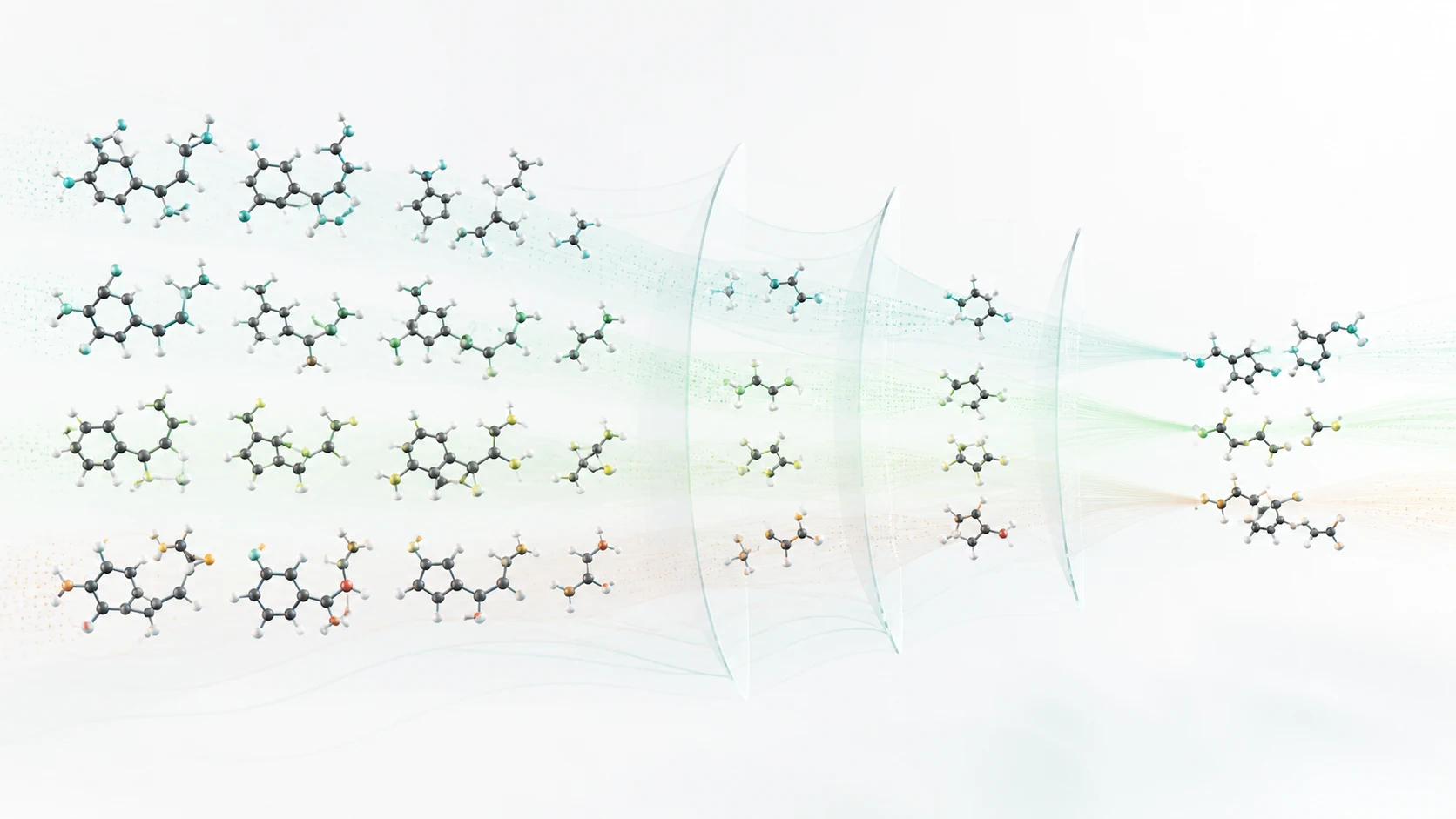
mltox auto-detects what you submit and routes it to the appropriate model — a protein is never scored by a small-molecule QSAR. Real-world outcomes feed back in.

  1. 01

    Submit

    Paste a SMILES, InChI, MOL/SDF, or a FASTA/amino-acid sequence. No account, no setup.

  2. 02

    Detect & featurize

    Format is auto-detected. Small molecules are featurized (RDKit or a pure-Python fallback); biologics get a sequence-liability pipeline.

  3. 03

    Model predicts

    Per-endpoint gradient-boosted classifiers, or learned per-allele epitope models — each with calibrated confidence and an applicability-domain gate.

  4. 04

    Report & feedback

    A structured report with rationale. Submit clinical/lab outcomes; weighted retraining folds them back into the models.

mltox prediction pipeline and feedback loop Input is detected and featurized, scored by the models, and returned as a safety report. Real clinical and lab outcomes are submitted back, stored with a trust weight per source, and folded into a weighted retrain that updates the endpoint models. PREDICTION LEARNING LOOP — YOUR EXTERNAL DATA Input SMILES · MOL · FASTA Detect & featurize format router Models QSAR · biologic analysis Safety report calibrated · conformal you run the experiment Clinical & lab outcomes trial · in-vivo · assay Feedback store weighted by source trust Weighted retrain seed + all feedback refines the endpoint models

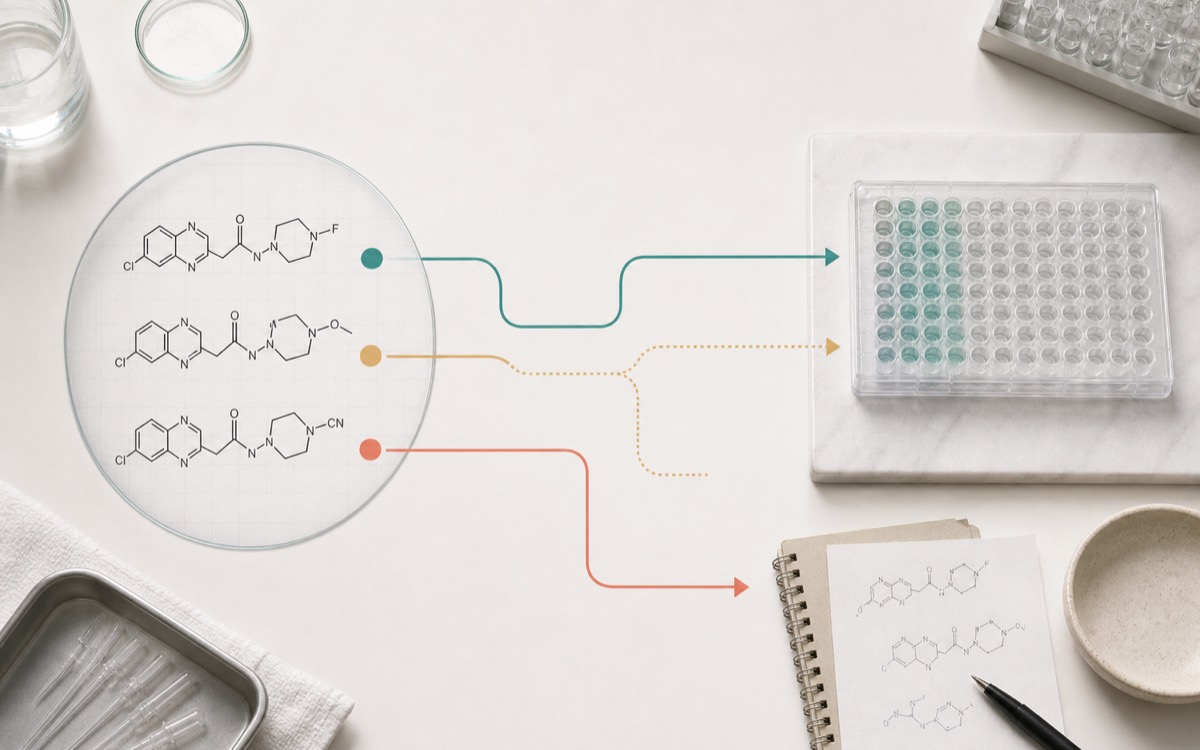
How the loop closes. Every report is a prediction. When a real result comes back — a clinical readout, an in-vivo study, a bench assay — you submit it as feedback. Each outcome is stored with a trust weight based on its source (a clinical trial counts for more than a literature note), then folded into a retrain over the seed data plus all accumulated feedback. That updated model scores your next molecule. The more real-world data you feed it, the more it is tuned to your chemistry.

Scope note: the fine-tune loop updates the small-molecule endpoint models. The biologics epitope models are trained separately on curated IEDB data and are not retrained on submitted outcomes.

What it screens

Two deliberately distinct engines

The small-molecule models don't apply to a 300-residue protein — so proteins get a real sequence-based analysis instead of a fake QSAR score.

Small molecules

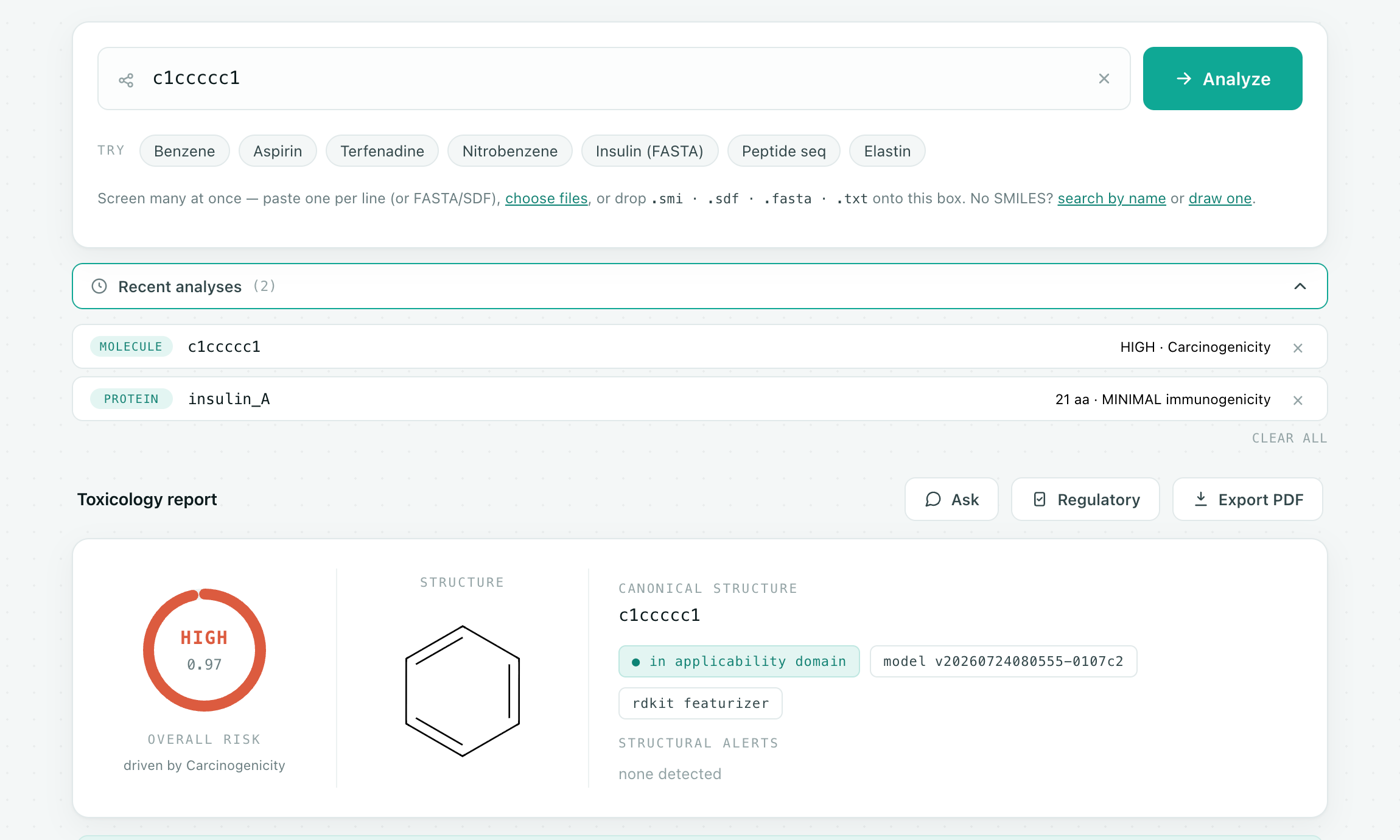
SMILES · InChI · MOL/SDF → QSAR toxicology report

  • Eight hazard endpoints with calibrated probability
  • Structural-alert (toxicophore) matches with rationale
  • 90% split-conformal prediction sets
  • Applicability-domain novelty gate + 2D depiction
  • Scaffold-split evaluation (no analog leakage)

Proteins & biologics

FASTA · sequence → immunogenicity + developability

  • Per-allele MHC-II T-cell epitope models (IEDB-trained)
  • Humanness axis separates self-tolerated from non-human risk
  • Deamidation, isomerization, oxidation & glycosylation liabilities
  • CamSol-style continuous solubility profile
  • Designs, not just scores — de-immunization candidates
Coverage

Eight toxicology endpoints

Each is an independent binary hazard model; severity weights how much it drives the overall risk band.

Carcinogenicitytumor formation on chronic exposure
Acute systemic toxicitylow LD50 after single exposure
Cardiotoxicity (hERG)QT prolongation / arrhythmia
Developmental toxicityteratogenicity
Hepatotoxicitydrug-induced liver injury
Mutagenicity (Ames)bacterial reverse mutation
NeurotoxicityCNS / peripheral effects
Skin sensitizationallergic contact dermatitis
Biologics engineering

It doesn't just score — it proposes redesigns

A suite of sequence-aware capabilities for antibody and protein engineers. Each is an in-silico hypothesis to prioritize wet-lab work, never a verified fix.

Junctional-neoepitope scanning

In fusions and multispecifics, flags T-cell epitopes created at the seam — present in neither parent domain — across auto-detected linkers.

De-immunization suggester

Proposes conservative BLOSUM62 substitutions the model predicts remove an epitope — anchors first, Cys/Pro/glyco fixed, with a greedy best-pair fallback.

Antibody CDR-awareness

Detects VH/VL, annotates CDR1/2/3 vs framework, and tags a risk as a redesign target (CDR) or a humanization gap (framework).

Expanded HLA panels

Selectable epitope panels — HLA-DR, DR/DQ/DP, and a supplementary class-I CD8 panel — each per-allele CV-AUC gated (0.80–0.93).

CamSol-style solubility

A continuous per-residue intrinsic-solubility profile from hydrophobicity, charge and β-propensity — flags aggregation-prone regions.

Calibration + conformal

Every endpoint is isotonic-calibrated and carries a 90%-coverage conformal set — a two-way {clean, hazard} means “can’t distinguish.”

ESMFold surface refinement

Optionally folds the sequence to down-weight buried liabilities, up-weight exposed ones, and cluster conformational patches. GPU-gated; degrades gracefully.

Plain-language rationale

Every report explains why — the drivers behind the overall band and the developability call, in language a reviewer can act on.

Honest by design

Calibrated confidence beats a confident guess.

A safety tool that overstates certainty is worse than none. mltox is built to tell you when it doesn’t know — and to keep its numbers honest about novel chemistry.

Try it on your molecule →
  • Scaffold-split evaluation

    AUCs are measured across Bemis–Murcko scaffold groups, so the numbers reflect novel chemistry — not analog leakage from the training set.

  • Applicability-domain gate

    Structures unlike anything seen in training are flagged low-confidence instead of extrapolating a confident-looking number.

  • Conformal prediction sets

    90%-coverage sets quantify ambiguity: a set containing both labels is an explicit “can’t distinguish,” not a silent coin flip.

  • Unvalidated-hypothesis framing

    Every biologics output is labeled an in-silico hypothesis on an unvalidated model — a capability to prioritize experiments, not a verified answer.

Screen your first molecule in under a minute.

No signup. Paste a structure or a sequence and read the report.